

So look the thing about architecture in New York City is that it never really sits still you know. It is like this huge living breathing mashup of five centuries smashed together on top of each other and then something new gets built and suddenly the whole street feels different. When you walk around Manhattan or Brooklyn or literally anywhere really really you feel like you are walking through a diary that someone kept over hundreds of years but the handwriting keeps changing and half the pages are ripped out and sometimes you find a note from the 1600s hiding in a corner. And it all started because a handful of Dutch settlers showed up one day with wooden shoes and a very practical sense of how a town should work.
I remember the first time I wandered down Pearl Street and someone casually said oh yeah these weird little bends come from Dutch times and I thought wait you mean the chaos actually has a reason. And it does. New York grew out of messy beginnings and that messy soul is still kind of everywhere.
This whole story seriously stretches from tiny Dutch gabled houses to the Chrysler Building glowing like a crown and then straight into pencil thin skyscrapers that look like they might blow over if I just breathed too hard. So yeah. This is the journey.
early dutch architecture in new york
The earliest chapter of architecture here was honestly kind of scrappy. When the Dutch first landed and called this place New Amsterdam they were mostly thinking about trade not beauty. So the buildings reflected that. Solid brick walls short and chunky roofs big stoops that kind of lifted you above street mud and the cold. Very practical people these Dutch settlers.
You would see those stepped gables the kind that look like stairs going up the roofline. And narrow windows with wooden shutters that would slap around on windy days. I imagine the sound was kind of charming or maybe annoying depends on how hungover you are.
Some people do not realize that the weird zigzag streets downtown are literally fossils from the Dutch period. They built around the coastline and the old cow paths and whatever else so it refused to be neat. Honestly I respect that so much because nothing in Lower Manhattan feels planned and that is kind of the point.
And sure almost none of the original Dutch buildings survived because time and development are not sentimental but the vibes stayed. Places like Stone Street still echo that old world vibe. Fraunces Tavern too even if it has been renovated so many times it is basically a historical remix album but still.
british era shift and early american styles
When the British grabbed the place and renamed it New York everything started looking more balanced more symmetrical more we are very serious about our architecture thank you. They brought Georgian and then Federal style which used red brick and white trim and had a sort of crisp polite vibe.
Federal Hall is like this dramatic symbol of that era. Big columns. Broad steps. It almost insists that the city behave itself which it never did of course.
There were rows of simple brick houses with neat little doorways and proper proportions. Sometimes walking through parts of the Village you get flashbacks to that era like the city accidentally kept a few pages of an old chapter.
the nineteenth century explosion brownstones beaux arts and big ideas
By the 1800s New York was basically a teenager hitting a growth spurt too fast. Immigrants pouring in factories chugging capitalism booming and the architecture tried to keep up sometimes successfully sometimes a little lopsided.
And the brownstones oh my god the brownstones. They became the trademark home of the city. Brooklyn Heights Park Slope Harlem Upper West Side these neighborhoods became entire seas of warm brown sandstone. The steps the stoops the carved details that look like someone spent way too many hours doing stone lacework. Even if you never lived in one you kind of feel like you did because every movie ever uses one.
Then you had SoHo with its cast iron buildings and at first I did not get why cast iron mattered. Then I learned that iron could be molded into crazy detailed façades so architects basically played with giant metal Legos. That is why SoHo has those huge windows perfect for sun and artists and now overpriced boutiques.
By late nineteenth century New York had money. Like real look at me I am the center of the universe money. And when you have that kind of money apparently you start building Beaux Arts stuff. Enormous libraries dripping in marble giant train stations with celestial ceilings museums that look like palaces. Grand Central New York Public Library the Met. These buildings are like love letters to classical Europe written with a fountain pen dipped in pure drama.
the birth of the skyscraper
Then came the moment the city decided horizontal wasn’t enough. It wanted to go up. Way up. And honestly this is where New York architecture starts feeling like a superhero origin story.
The elevator was the real hero here. Before that no one wanted to climb fifteen flights of stairs unless they were training for some medieval knight audition. Steel frames also changed everything because suddenly walls were not doing all the work and the building could rise taller without collapsing under its own drama.
The Flatiron Building looked like a giant slice of pizza just planted at a weird intersection and people freaked out about it maybe blowing over. Spoiler it did not.
Then the Woolworth Building this neo gothic skyscraper that looks like someone stretched a cathedral and told it to go get a job. It was the tallest in the world for a bit and still feels magical when you see it glowing at night.
art deco era the sparkly golden age
And then boom the 1920s and 30s hit and New York basically invented architectural glamour. The Art Deco period is honestly the era that lives in everyone’s imagination when they think classic NYC. Sharp angles bold lines patterns that look like sunrise rays and materials that shimmer even when the sun is doing nothing.
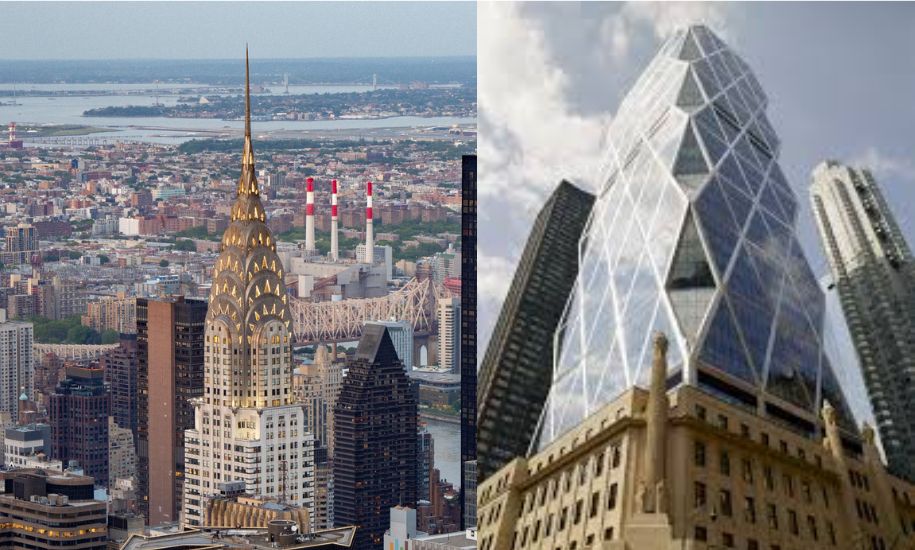
The Chrysler Building is so gorgeous it hurts a little. All those stainless steel arches stacking up like some cosmic crown. The Empire State Building too rising like it is trying to poke the clouds. Rockefeller Center with its sleek shapes and its sculpture and its skating rink vibes every winter. This era is like the moment the city decided hey what if we look incredible forever.
I swear every time I see these buildings I feel like I am in a movie even when I am just running late.
modernism the glass box generation
After World War Two the mood changed. Ornament was out efficiency was in. Architects said we are done with sparkles give us rectangles and steel and glass and sharp clean lines. And honestly a lot of these buildings look like extremely serious grown ups.
The Seagram Building is probably the most important one. It is this perfect pure glass box designed with quiet confidence. Lever House too with its green tinted glass rising like a vertical sheet of ice. These buildings were all about clarity precision minimalism. Like the architectural equivalent of someone with an immaculate desk and a very expensive pen collection.
Midtown basically turned into a field of tall glass trees all trying to look modern sophisticated and totally unbothered.
postmodernism and the weird fun comeback
By the 70s and 80s architects got bored of the whole less is more thing and swung back into more is more but in a quirky sarcastic way. Suddenly buildings had decorative tops again playful shapes unexpected colors. It was like architecture decided to stop being polite.
The AT and T Building with that Chippendale top is the poster child of this era. It literally looks like furniture. And that was the point. Architecture was allowed to joke again.
At the same time older neighborhoods got saved through preservation movements because people finally realized hey maybe bulldozing everything is not the best hobby. So thanks to that we still have beautiful pieces like Grand Central and historic districts in Brooklyn and Manhattan.
the new century new ambitions new shapes
Enter the 2000s and architecture just started experimenting with wild new ideas. Technology made crazy shapes possible. The city kept redesigning itself again and again because apparently that is a local hobby.
One World Trade Center rose as this tall crisp reflective symbol. Hudson Yards arrived with its expensive shiny futuristic vibe and the Vessel which looks like a beehive that spent too much time at the gym. The High Line changed the entire idea of public space by turning an old railway into a hanging garden that snakes through buildings and makes the whole city feel calmer for a minute.
And then the supertall pencil towers came. 432 Park Avenue this absurdly skinny tower that looks like someone stretched a salt shaker into the sky. 111 West 57th even thinner like a ruler balancing on its end. I do not know how engineers make these things not fall over but I trust that they paid attention in class.
the social story behind the buildings
Architecture here is not just shapes it is stories. It tracks migration waves rising wealth falling wealth political fights cultural struggles everything. You see old immigrant neighborhoods full of tenements where generations crammed into tiny rooms. You see churches synagogues mosques temples built by communities trying to root themselves in a new world.
You see the grid plan of 1811 which basically steamrolled its way across Manhattan like a giant mathematical bulldozer. And then Robert Moses in the mid 1900s building highways and bridges and parks and sometimes bulldozing neighborhoods without blinking which still sparks arguments today.
New York always reflects the people who shape it for better and worse.
why the architectural legacy matters
New York’s architecture is iconic because it never picks one identity and sticks to it. It is variety stacked on variety contradictions sitting next to each other like roommates who argue but secretly get along.
Dutch roots
Georgian order
Brownstone charm
Cast iron ingenuity
Art Deco glamour
Modernist calm
Postmodern weirdness
Hyper modern experimentation
Everything overlaps and somehow it works. It tells you a story of ambition reinvention survival and endless curiosity.
When people talk about New York being a symbol it is not just about money or culture or the whole city that never sleeps thing. It is the skyline. The stoops. The rooftop water towers. The shadow of the Empire State stretching across the city at sunset. All those moments that feel like postcards even when you are living them.
It is a city that keeps building and keeps remembering and keeps forgetting all at once.
And that is why it feels alive.
Published on gamersphere